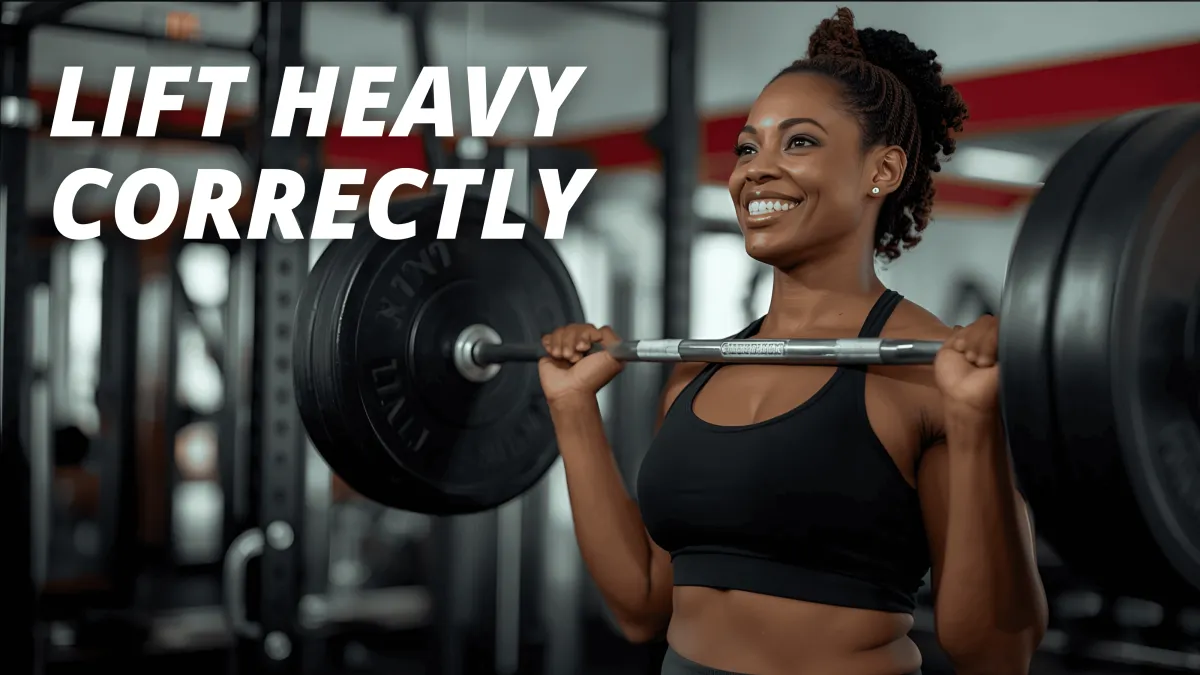
What Lifting Heavy Really Means After 40 (And Why It Matters More Than Ever)
Lifting heavy has become a buzzword lately. You see it all over social media and hear it in almost every fitness conversation. And honestly, I love that. Especially for women in midlife who are finally being told the truth. Strength matters.
But with the rise in popularity comes a whole lot of noise. People selling gimmicks. Coaches overcomplicating the basics. Random influencers handing out rigid rules that do not fit your real life.
So today I want to clear it all up.
I want to tell you exactly what lifting heavy means, what it does not mean, and how to make it work in your actual schedule so you can get toned, strong and feel incredible.
Everything below comes straight from the transcript and the coaching strategies I use every day with real clients over 40. And they work. I know they work because I see the results week after week.
Let’s dive in.
What Lifting Heavy Does NOT Mean
Before we talk about the real strategy, we need to clear up the myths.
1. It does not mean just using weights.
Picking up weights far below your strength level will not stimulate anything. It's like expecting results from lifting the same grocery bag every week. It makes no sense because your body already adapted to it.
2. It does not mean stopping when you feel tired.
That first burn is not your stop sign. It is simply your body getting warmed up. Stopping too early is the fastest way to hit a plateau and not see any significant changes.
3. It does not mean using the same weight over and over.
If you reach for the same 15 pound dumbbells every workout, you are maintaining at best. You are not building. You are not progressing. You are not creating new adaptation. And if you want more tone and shape, you need that progression.
4. It does not mean believing social media formulas.
This many reps with this weight equals this result... Nope.
Everyone has different strength levels, different recovery abilities and different needs. Progress comes from effort and execution, not a cookie cutter chart.
Now that the myths are out of the way, we can talk about what lifting heavy truly looks like.
What Lifting Heavy Actually Means
Lifting heavy means training with enough effort to challenge your muscles in a meaningful way.
It means getting close enough to failure that your body is forced to adapt. Your muscles need a signal that says, hey, it is time to get stronger, build more muscle and improve bone density.
That adaptation only happens when the weight or the reps are challenging enough.
One of the simplest and safest ways to measure this is through something called technical failure.
Understanding Technical Failure
Technical failure is a game changer for people over 40.
It is not the dramatic, over the top failure you see in old bodybuilding videos where someone is screaming while their buddy hoists the weight up for them.
Technical failure simply means this:
You keep good form, but eventually your muscles say "I got nothing left" and you stop because you can no longer perform a clean rep.
For example, with a bicep curl:
Your elbow stays tight to your side.
Your form looks clean.
Then suddenly your upper body wants to swing or use momentum to lift the weight.
That is your signal.
That is technical failure.
This matters because the closer you get to technical failure, the more effective the stimulus is for building muscle and bone.
And here is the cool part for people in midlife.
You do not need to go all the way to failure every time.
Going one to two reps shy of failure is more than enough once you have experience knowing what true technical failure feels like.
This keeps progress moving without crushing your recovery.
Why This Matters Even More After 40
As we age, our ability to recover changes. The fitness strategies that worked in your twenties simply do not work the same way anymore.
If you push too hard too fast, your recovery cannot keep up and the risk of injury goes up.
If you do too little, your body has no reason to adapt.
Strength training after 40 requires finding the sweet spot in the middle.
This is why understanding technical failure and progressive overload is so essential.
You want enough challenge to stimulate change but not so much that you burn out.
And that brings me to one of my favorite tools for clients.
The Rule of Five
The rule of five is simple.
It is effective.
It works for beginners and experienced lifters alike.
And it is especially powerful for people over 40.
Here is how it works.
I have clients aim for 10 repetitions on each exercise for 3-4 sets (rounds).
On their final working set they choose one of these options:
Add five pounds and perform at least five reps
or
Try to add up to five reps with the same weight
Either choice creates progression.
Either one produces the stimulus your body needs.
And either one is enough to help you steadily improve without increasing risk of injury.
Clients are always surprised at how much stronger they really are when they try this. Many realize they have been underloading for years.
The rule of five is the antidote to guessing.
It gives structure, clarity and a simple way to progress so you can build more muscle & bone.
What If You Hit a Plateau
If you stop progressing using the rule of five, do not panic. There is always a reason and it usually has nothing to do with your training plan.
A plateau is often your body saying something else is off.
Ask yourself:
How is my sleep
How is my stress
How is my hydration
How is my recovery
Am I doing too much other activity that is interfering with strength training
Most people assume they need a harder workout.
But often the real fix is better recovery.
Your workouts give your body the signal to grow. Rest is where strength, muscle & bone are built.
Without proper rest it's like you yelling at your kid to clean up their room, but they never end up doing it.
Why High Intensity Programs Often Fail People Over 40
A lot of popular programs use massive volume because they know most people are not lifting with enough weight or good enough form to get results. So they crank up the reps and hope fatigue does the job.
But high volume with light weights can create unnecessary joint stress, burnout and plateaus.
It is not that these programs are “bad.”
They just are not built for long term progress, especially in midlife.
Lifting heavy (intelligently) solves that.
It builds real muscle.
It boosts metabolism.
It strengthens joints instead of wearing them out.
It creates resilience that carries into every part of life.
The Real Goal of Lifting Heavy After 40
It is not to lift the heaviest weight in the gym.
It is to:
Feel strong
Age well
Protect your joints
Build muscle that supports your daily life
Increase bone density
Boost metabolism
Have more energy for your family, career and life
Move pain free
And feel damn good in your clothes
Lifting heavy is not about being extreme.
It is about being intentional.
You do not need endless reps.
You do not need random high intensity workouts.
You do not need to outwork your body with constant cardio.
You need strategic strength training that challenges you at the right level and grows with you over time.
Your Next Step
Next time you walk into the gym, try the rule of five.
Challenge yourself.
See what you are capable of.
Strength is not about perfection.
It is about showing up, pushing yourself a bit and letting your body respond the way it was designed to.
This is how people in their 40s, 50s and beyond get toned, feel energized, boost their metabolism and build a body they can depend on for years.
If you want help doing this the right way, without wasting years on guesswork, this is exactly what I coach my FIT40 clients through every day.
You do not have to figure this out alone.
All you need is a smart plan that fits your real life.
Let’s get you strong.
Click here to set up a free consultation to see if FIT40 Coaching is right for you: https://fit40coaching.com/coachingconsultation


